
If you’ve been keeping an eye on the market this year, there’s no doubt you’ve found yourself questioning what you should really be doing with your money. There has to be a better avenue in place of the sinking ship that is today’s stock market, right? Whether you’ve sold real estate or a business or have profits from selling stocks or bonds, as we close out the year both personally and professionally, don’t let the opportunity to maximize your capital gain expire.
Capital gains are a significant component of investment returns. However, these gains can be subject to substantial taxation, potentially eroding a considerable portion of your profits. When might this scenario occur?
Selling a Business
Imagine after nearly four decades of owning and operating a business, you determine it is time to retire. The sale should be a celebratory milestone, a testament to your hard work and dedication. But the fear of receiving a hefty tax bill due to capital gains from the sale threatens to derail your retirement plans.
Offloading Stock
Offloading stock, whether to reinvest your capital or simply access your gains, can be a strategic move in your financial journey. The prospect of offloading stock for profit can be enticing, yet, capital gains tax can be a real obstacle.
Selling Land or Real Estate
Turning a profit on the sale of land or real estate can be a satisfying achievement, but capital gains taxes can take a bite out of your earnings. Say you own a duplex. The property, once a promising source of passive income, has over the years become a burden. But, the prospect of selling the duplex has triggered fears of a tax liability.
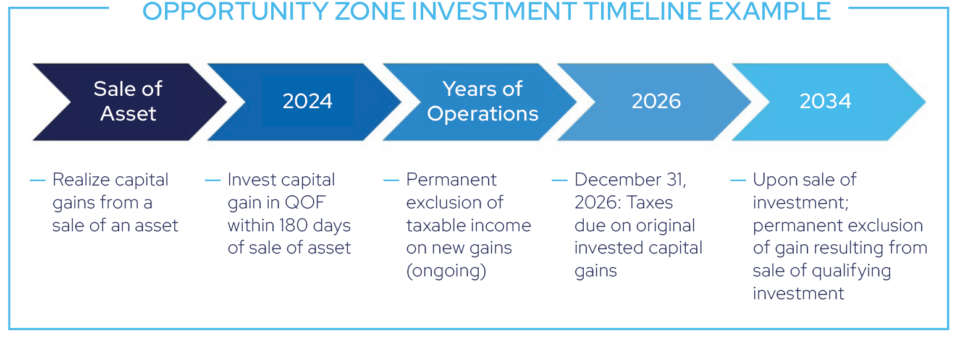
Keep in mind, all these scenarios have the potential to remain celebratory if approached correctly. Investors seeking tax-efficient strategies have been gravitating toward the Opportunity Zones tax incentive, which is an economic development tool that allows people to invest in economically distressed areas. Opportunity Zones offer tax benefits to investors if they timely invest those gain amounts (within 180 days of realization) in a Qualified Opportunity Fund (QOF). Practically speaking, a QOF is the investment vehicle used to fund a project within the Opportunity Zone (OZ).
Investing in a QOF may provide the following significant benefits:
Temporary Deferral of Taxes on Previously Earned Capital Gains: OZ investors may defer tax on the invested gain amounts until the earlier of December 31, 2026, or when the asset is disposed of.
Permanent Exclusion of Taxable Income on New Gains: Where an investor holds her interest in the QOF for 10 years or more and after such 10-year holding period has been surpassed, the investor may be able to permanently exclude from US federal tax any gain earned from the QOF investment, which includes depreciation recapture.
Enhanced Returns: By investing in a multifamily real estate project that is part of an OZ, investors can potentially benefit from these enhanced returns while also enjoying the tax benefits associated with QOFs.
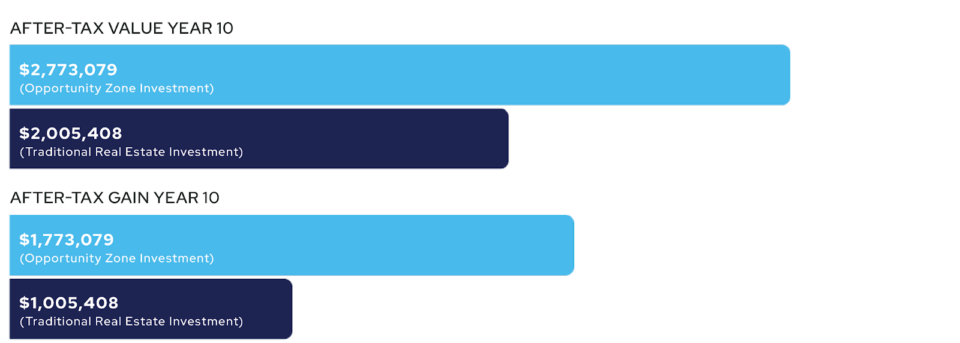
Potential Payoff of Invested Capital Gain of $1,000,000
Opportunity Zone Investment vs. Traditional Real Estate Investment