
Stacks of coins with fluctuating stock and financial charts overlaid, symbolizing investment in stocks, bonds, and real estate. Text reads 'Stocks, Bonds, and Real Estate Asset - Volatility and Performance Comparison.' Roers Companies logo and 'Perspectives' label in the top right corner.

Stocks, Bonds, and Real Estate Asset Volatility and Performance Comparison

Jul 11, 2023

Stability vs. Returns

Savvy investors know that diversification is key to overall portfolio performance. Recent economic
headlines on inflation, interest rates, and bank instability have led many individuals to pull back from new investments. Historical data shows us that those who seek out stable investment opportunities in uncertain market conditions — such as multifamily real estate — experience less volatility and greater long-term growth potential.

Volatility Comparison

Publicly traded investments tend to have more risk

By comparing annual returns since 2000 across stocks (S&P 500), bonds (Bloomberg Agg.), public real estate trusts (NAREIT), private commercial real estate (NCREIF), and multifamily real estate (CoStar Multifamily), it’s clear that some are more volatile than others. While stocks and publicly traded REITs do boast some of the highest historical highs, they also experienced the most extreme losses during the Great Recession and saw significant volatility throughout the past 20+ years.
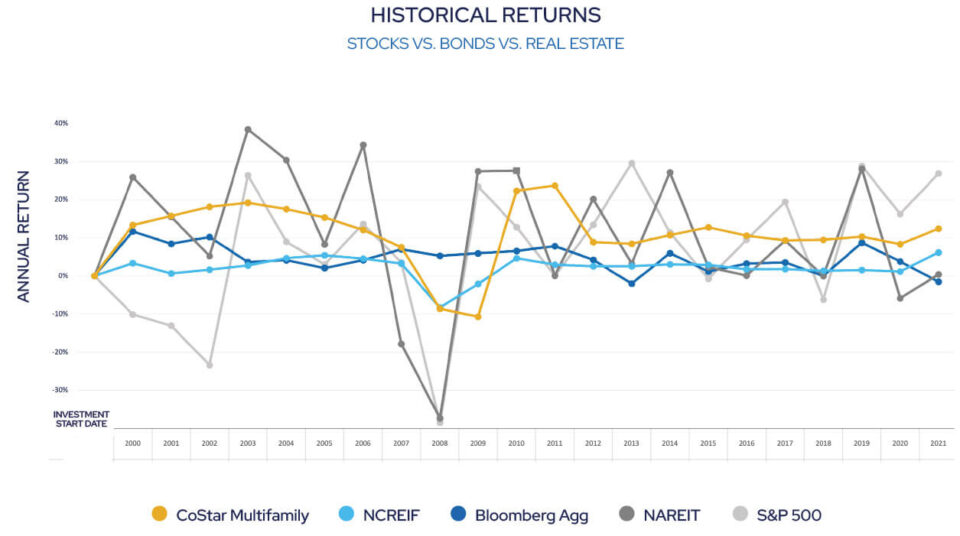
Line chart comparing historical annual returns from 2000 to 2021 for stocks (S&P 500), bonds (Bloomberg Agg), and real estate (CoStar Multifamily, NCREIF, NAREIT). Each category is represented by a distinct colored line.

Multifamily real estate investments offer less volatility than stocks and REITs, are not correlated to the stock market, and offered better annual returns than bonds in all but two years since 2000.

Performance Comparison

Comparing $10,000 investment performance

If you compare the performance of a $10,000 investment made in the year 2000 over time, you can see that the growth in multifamily outperforms other asset types, while offering greater stability than typical stocks or REITs.
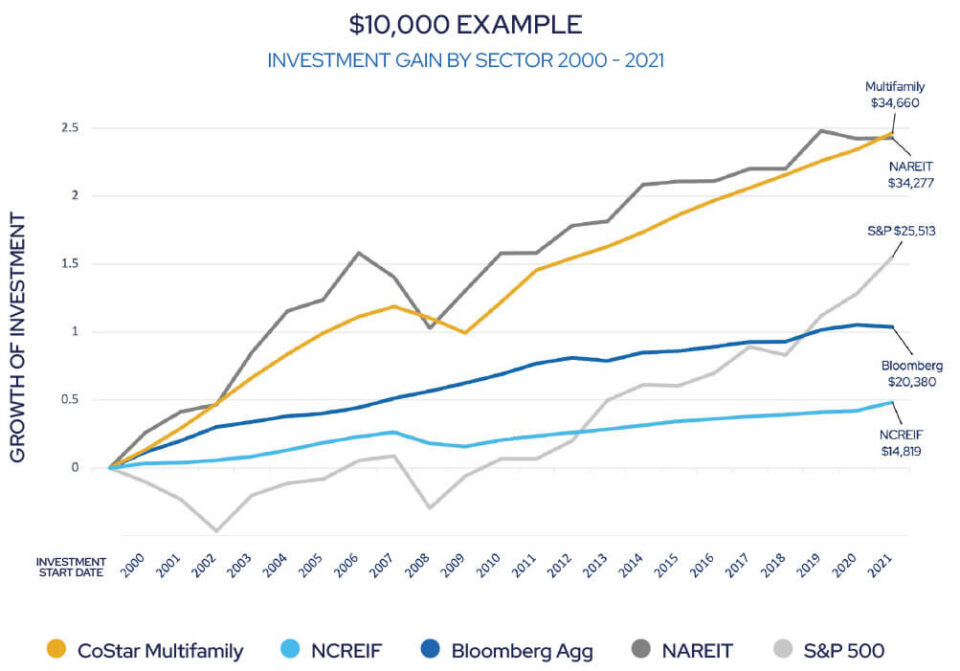
Line graph illustrating the growth of a $10,000 investment from 2000 to 2021 across different sectors, including CoStar Multifamily, NCREIF, Bloomberg Agg, NAREIT, and S&P 500. Multifamily and NAREIT lead with returns exceeding $34,000, while NCREIF lags at $14,819.

Most investors will benefit from a diverse portfolio with a mix of high-growth and stable investment types. If private multifamily investments aren’t part of your asset mix, it might be time to revisit your strategies.

SOURCES:
“CoStar”
“REIT Data.” Nareit, May 8, 2023. https://www.reit.com/data-research.
“S&P 500 Historical Annual Returns.” MacroTrends. Accessed May 5, 2023. https://www.macrotrends.net/2526/sp-500-historical-annual-returns.
Thompson, Michael. “Bloomberg US Aggregate Bonds Annual Returns.” UpMyInterest. Accessed May 5, 2023. https://www.upmyinterest.com/bloomberg-us-aggregate-bonds/.
“U.S. NCREIF Property Index Returns 2022.” Statista, February 23, 2023.


NO OFFER OF SECURITIES; DISCLOSURE OF INTERESTS: Under no circumstances should any material or information contained herein be used or considered as an offer to sell or a solicitation of any offer to buy an interest in any investment. Any such offer or solicitation will be made only by means of a confidential offering memorandum relating to the particular investment. Access to information about investments with projects undertaken by Roers Companies LLC, Roers Companies Project Holdings LLC, or any of their respective affiliates is limited to investors who qualify as accredited investors within the meaning of the Securities Act of 1933, as amended. Investment outcomes vary. Past success does not guarantee future results. Historical return details available.

DISCLAIMER RE: THIRD PARTY SOURCES: The material contained herein is general information for educational purposes only. Information is based on data gathered from what we believe are reliable sources. It is not guaranteed as to accuracy, does not purport to be complete and is not intended to be used as a primary basis for investment decisions. It should also not be construed as advice meeting the particular investment needs of any investor.

Subscribe to Updates

Sign up to receive email updates with market insights and investment opportunities from Roers Companies.