When Jay Parsons joined Roers Companies at our Annual Investor Conference in June to discuss the state of the multifamily market, one message stood out above all others: today’s apartment market is fundamentally a supply story.
Over the past several years, the industry has worked through one of the largest waves of multifamily deliveries in modern history. That surge in new supply created temporary pressure on rents, occupancy, and concessions across many markets, leading some to question the strength of apartment demand.
As we reach the midpoint of 2026, the outlook Parsons outlined is largely playing out as expected. Demand has remained resilient, occupancy at stabilized communities has held near long-term averages, and the development pipeline is beginning to contract meaningfully. While recovery remains measured rather than dramatic, the industry is beginning to transition into a more balanced operating environment.
The Supply Wave Is Beginning to Recede
The most important trend shaping today’s multifamily market is the sharp decline in future apartment deliveries.
While new deliveries remain elevated in 2026 as projects started during the low-interest-rate era continue to come online, the number of new multifamily starts has fallen significantly. As a result, industry forecasts anticipate a substantial decline in annual completions over the next several years.
This matters because apartment fundamentals often improve when supply growth moderates while demand remains steady. Fewer new communities entering the market means less competitive pressure, improving occupancy trends and stronger potential for rent growth across stabilized assets.
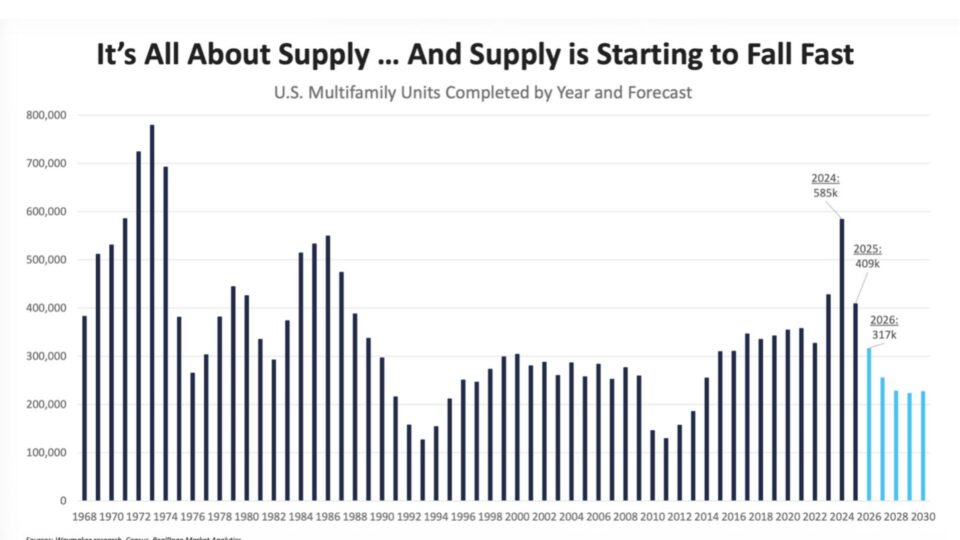
The declining development pipeline is one of the clearest indicators that the industry’s recent challenges are likely to ease over time. Rather than requiring a dramatic increase in demand, improving conditions can occur simply because fewer new units will be delivered to compete for renters.
Demand Remains Strong
While much of the industry’s attention has focused on supply, demand has remained surprisingly durable.
One of Parsons’ key observations was that multifamily’s recent challenges have largely been the result of unusually high supply levels rather than weak renter demand. Household formation has continued, apartment absorption has remained healthy, and occupancy at stabilized communities has held relatively steady despite historic delivery volumes.
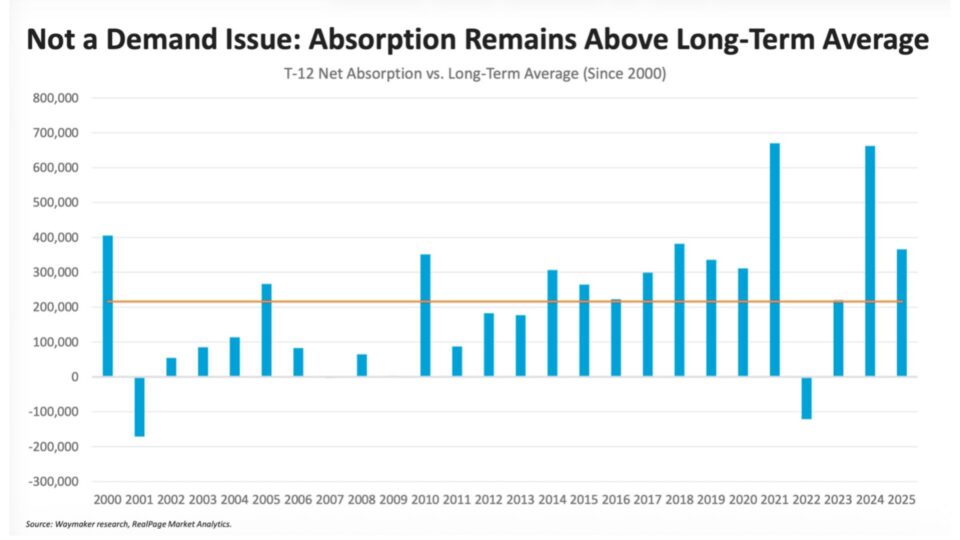
The distinction is important. Demand has not disappeared. Instead, it has been temporarily diluted by the sheer volume of new units entering lease-up.
The Renting Stage of Life Is Extending
Long-term demographic trends continue to reinforce demand for rental housing. As home prices and mortgage rates remain elevated relative to historical norms, the path to homeownership has become increasingly difficult for many households. Parsons noted that today’s housing market is extending the traditional renting stage of life, with more consumers remaining renters for longer periods and delaying first-time home purchases.
The result is a growing renter pool supported by structural affordability challenges within the for-sale housing market.
In many markets, the financial gap between renting and owning remains substantial. Combined with historically limited housing inventory and elevated borrowing costs, these dynamics continue to support apartment demand even as economic growth moderates. This trend represents one of the most important long-term tailwinds for multifamily housing and reinforces why demand is expected to remain resilient despite changing market conditions.
A K-Shaped Recovery Is Emerging
While overall market conditions are improving, recovery is not occurring evenly.
One of the themes Parsons highlighted was the emergence of a “K-shaped” apartment market, where performance is increasingly diverging across asset classes, locations, and operators.
Newly delivered Class A communities continue to attract significant demand, particularly as concessions narrow rent spreads between newer and older properties. Many renters who may have historically rented Class B product have been able to move into higher-quality communities due to elevated supply and competitive pricing.
At the same time, older communities and assets with weaker competitive positioning may continue to face pricing pressure.
The result is widening performance dispersion across the industry. While favorable supply-demand dynamics benefit the broader market, property-level execution is becoming an increasingly important differentiator.
For owners, success is no longer determined solely by market conditions. Construction quality, resident experience, operational discipline, and asset positioning are playing a larger role in performance outcomes.
Mid-Year Check-In: How the Market Is Tracking
At the beginning of the year, many industry forecasts anticipated a gradual transition toward stabilization. Through the first half of 2026, that forecast remains intact.
Supply conditions are evolving largely as expected, with the peak delivery period now behind us. Demand remains healthy, occupancy has remained relatively stable, and rent growth has begun showing signs of improvement as competitive pressure gradually declines.
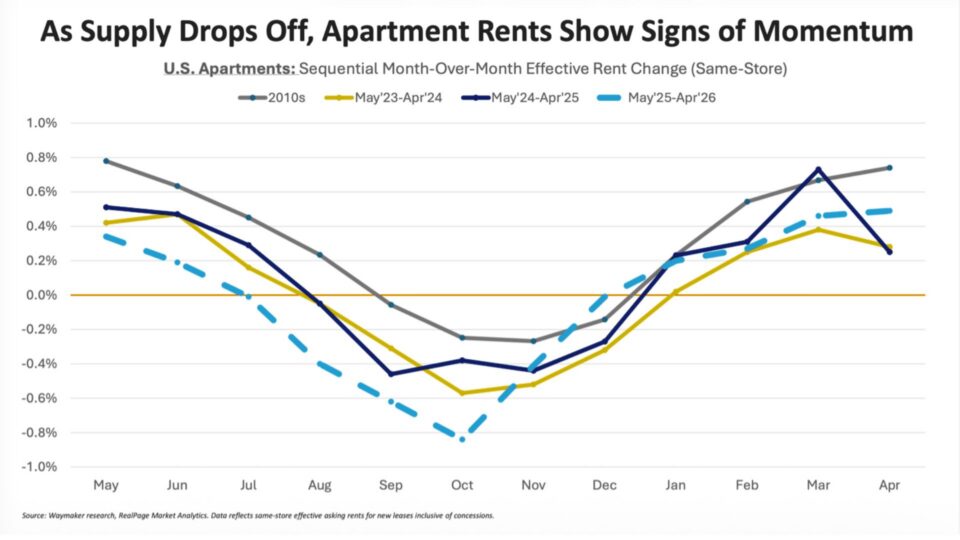
Importantly, this does not represent a rapid rebound. Instead, it reflects a market gradually rebalancing after working through an unprecedented amount of new inventory.
The first half of 2026 has reinforced what Parsons suggested in June: multifamily’s long-term fundamentals remain healthy, and improving conditions are increasingly being supported by declining supply.
Outlook: Positioning for the Next Phase
The multifamily sector is entering a different phase of the cycle.
The record supply wave that defined the last several years is beginning to recede, while the long-term drivers of demand remain intact. An expanding renter population, extended renter tenure, and a significantly smaller development pipeline are creating a foundation for improved operating performance over the coming years.
At the same time, market conditions are becoming increasingly selective. Strong macro fundamentals will continue to support the industry, but the benefits will not be distributed evenly. Asset quality, operational discipline, resident experience, and execution will play an increasingly important role in determining outcomes.
For vertically integrated operators like Roers Companies, this environment creates a meaningful advantage. By aligning development, construction, and property management within a single platform, decisions can be made more quickly, operational strategies can be implemented more effectively, and resident experience can be managed consistently throughout the asset lifecycle.
The story of 2026 is not one of rapid recovery. It is the beginning of a transition toward a more balanced market, characterized by falling supply, durable demand, and the potential for long-term, supply-constrained growth.
To learn more about the multifamily market and upcoming investment opportunities in multifamily real estate contact the investor relations team here.